enterprise platform
product strategy
Interaction Design
NASA · Earthdata
Transforming a Complex Data Ecosystem into an Intuitive Product Platform
Transforming a Complex Data Ecosystem into an Intuitive Product Platform
Transforming a Complex Data Ecosystem into an Intuitive Product Platform

Product Outcome
Established a scalable discovery ecosystem that unified navigation, information architecture, and interaction patterns across NASA's Earthdata platform.
Timeline
2023 – Present
2023 – Present
2023 – Present
Role
Senior Product Designer
Product Strategy
Interaction Design
Information Architecture
Design Systems
Senior Product Designer
Product Strategy
Interaction Design
Information Architecture
Design Systems
Senior Product Designer
Product Strategy
Interaction Design
Information Architecture
Design Systems
Reusable Template Slot
Swap this column for team, scope, tools, constraints, or platform context in future case studies.
Swap this column for team, scope, tools, constraints, or platform context in future case studies.
Swap this column for team, scope, tools, constraints, or platform context in future case studies.
The Problem
12+ distributed archive centers with independent navigation, terminology, and dataset structures creating fractured discovery experiences.
12+ distributed archive centers with independent navigation, terminology, and dataset structures creating fractured discovery experiences.
12+ distributed archive centers with independent navigation, terminology, and dataset structures creating fractured discovery experiences.
NASA Earthdata is an ecosystem of products supporting data discovery, APIs, cloud workflows, developer tools, and scientific research. As the platform expanded, users struggled to understand where to begin, how products connected, and which workflows best supported their goals.
NASA Earthdata is an ecosystem of products supporting data discovery, APIs, cloud workflows, developer tools, and scientific research. As the platform expanded, users struggled to understand where to begin, how products connected, and which workflows best supported their goals.
NASA Earthdata is an ecosystem of products supporting data discovery, APIs, cloud workflows, developer tools, and scientific research. As the platform expanded, users struggled to understand where to begin, how products connected, and which workflows best supported their goals.
As Senior Product Designer, I helped define a scalable product strategy by simplifying complex workflows, improving information architecture, and creating reusable design patterns that support both first-time users and technical experts.
As Senior Product Designer, I helped define a scalable product strategy by simplifying complex workflows, improving information architecture, and creating reusable design patterns that support both first-time users and technical experts.
As Senior Product Designer, I helped define a scalable product strategy by simplifying complex workflows, improving information architecture, and creating reusable design patterns that support both first-time users and technical experts.
Product Strategy
Aligning Product Vision Across a Growing Ecosystem
Aligning Product Vision Across a Growing Ecosystem
Aligning Product Vision Across a Growing Ecosystem
User flow mapping across multiple Distributed Active Archive Centers (DAACs) revealed that discovery wasn't a linear process; it was a network of interconnected journeys that the product needed to support.
User flow mapping across multiple Distributed Active Archive Centers (DAACs) revealed that discovery wasn’t a linear process; it was a network of interconnected journeys that the product needed to support.
User flow mapping across multiple Distributed Active Archive Centers (DAACs) revealed that discovery wasn’t a linear process; it was a network of interconnected journeys that the product needed to support.
I reframed the project from standardizing dataset pages to redesigning the discovery ecosystem and shifted the experience from navigating repositories to making informed decisions.
I reframed the project from standardizing dataset pages to redesigning the discovery ecosystem and shifted the experience from navigating repositories to making informed decisions.
I reframed the project from standardizing dataset pages to redesigning the discovery ecosystem and shifted the experience from navigating repositories to making informed decisions.
01
Design for the Ecosystem, Not Individual Pages
Instead of redesigning isolated dataset pages, I focused on the relationships between datasets, tools, documentation, and workflows. Addressing the ecosystem required a broader effort but solved the root cause of fragmented discovery.
Instead of redesigning isolated dataset pages, I focused on the relationships between datasets, tools, documentation, and workflows. Addressing the ecosystem required a broader effort but solved the root cause of fragmented discovery.
Instead of redesigning isolated dataset pages, I focused on the relationships between datasets, tools, documentation, and workflows. Addressing the ecosystem required a broader effort but solved the root cause of fragmented discovery.
02
Organize Around User Goals, Not Repository Structure
Research revealed that repository structures didn't match how users evaluated datasets. Rather than exposing comprehensive metadata upfront, I prioritized the questions users needed answered first:
Is this data relevant?
Does it cover my area and timeframe?
How do I access it?
Research revealed that repository structures didn’t match how users evaluated datasets. Rather than exposing comprehensive metadata upfront, I prioritized the questions users needed answered first:
Is this data relevant?
Does it cover my area and timeframe?
How do I access it?
Research revealed that repository structures didn’t match how users evaluated datasets. Rather than exposing comprehensive metadata upfront, I prioritized the questions users needed answered first:
Is this data relevant?
Does it cover my area and timeframe?
How do I access it?
03
Build Components That Scale
Thousands of datasets couldn't be supported with rigid templates. I designed flexible components that adapted to varying metadata, scientific disciplines, and download workflows while maintaining a consistent experience across the ecosystem.
Thousands of datasets couldn't be supported with rigid templates. I designed flexible components that adapted to varying metadata, scientific disciplines, and download workflows while maintaining a consistent experience across the ecosystem.
Thousands of datasets couldn't be supported with rigid templates. I designed flexible components that adapted to varying metadata, scientific disciplines, and download workflows while maintaining a consistent experience across the ecosystem.
research and discovery
Understanding the Ecosystem
Understanding the Ecosystem
Understanding the Ecosystem
Rather than jumping into solutions, I first needed to understand how people discovered and evaluated Earth science data across a fragmented ecosystem. Three research activities fundamentally changed how I approached the product.
Rather than jumping into solutions, I first needed to understand how people discovered and evaluated Earth science data across a fragmented ecosystem. Three research activities fundamentally changed how I approached the product.
Rather than jumping into solutions, I first needed to understand how people discovered and evaluated Earth science data across a fragmented ecosystem. Three research activities fundamentally changed how I approached the product.
User Flow Mapping
User Flow Mapping
User Flow Mapping
Mapped end-to-end discovery journeys to understand how users move between datasets, tools, and documentation, not just individual pages.
Mapped end-to-end discovery journeys to understand how users move between datasets, tools, and documentation, not just individual pages.
Mapped end-to-end discovery journeys to understand how users move between datasets, tools, and documentation, not just individual pages.
Content Inventory
Content Inventory
Content Inventory
Compared dataset pages across DAACs to identify patterns, inconsistencies, and opportunities for a unified information model.
Compared dataset pages across DAACs to identify patterns, inconsistencies, and opportunities for a unified information model.
Compared dataset pages across DAACs to identify patterns, inconsistencies, and opportunities for a unified information model.
Stakeholder Alignment
Stakeholder Alignment
Stakeholder Alignment
Validated research findings with DAAC teams and built consensus around a shared vision for a scalable discovery experience.
Validated research findings with DAAC teams and built consensus around a shared vision for a scalable discovery experience.
Validated research findings with DAAC teams and built consensus around a shared vision for a scalable discovery experience.
Information architecture
Connecting a Fragmented Discovery Journey
Connecting a Fragmented Discovery Journey
Connecting a Fragmented Discovery Journey
User flow mapping revealed that users moved fluidly between datasets, documentation, applications, and download workflows, often crossing multiple products before accomplishing their goal.
User flow mapping revealed that users moved fluidly between datasets, documentation, applications, and download workflows, often crossing multiple products before accomplishing their goal.
User flow mapping revealed that users moved fluidly between datasets, documentation, applications, and download workflows, often crossing multiple products before accomplishing their goal.
Instead of organizing navigation around NASA's internal structure, I organized it around user goals and the relationships between products. The resulting information architecture reduced cognitive load for new users while preserving efficient pathways for experienced researchers.
Instead of organizing navigation around NASA’s internal structure, I organized it around user goals and the relationships between products. The resulting information architecture reduced cognitive load for new users while preserving efficient pathways for experienced researchers.
Instead of organizing navigation around NASA’s internal structure, I organized it around user goals and the relationships between products. The resulting information architecture reduced cognitive load for new users while preserving efficient pathways for experienced researchers.
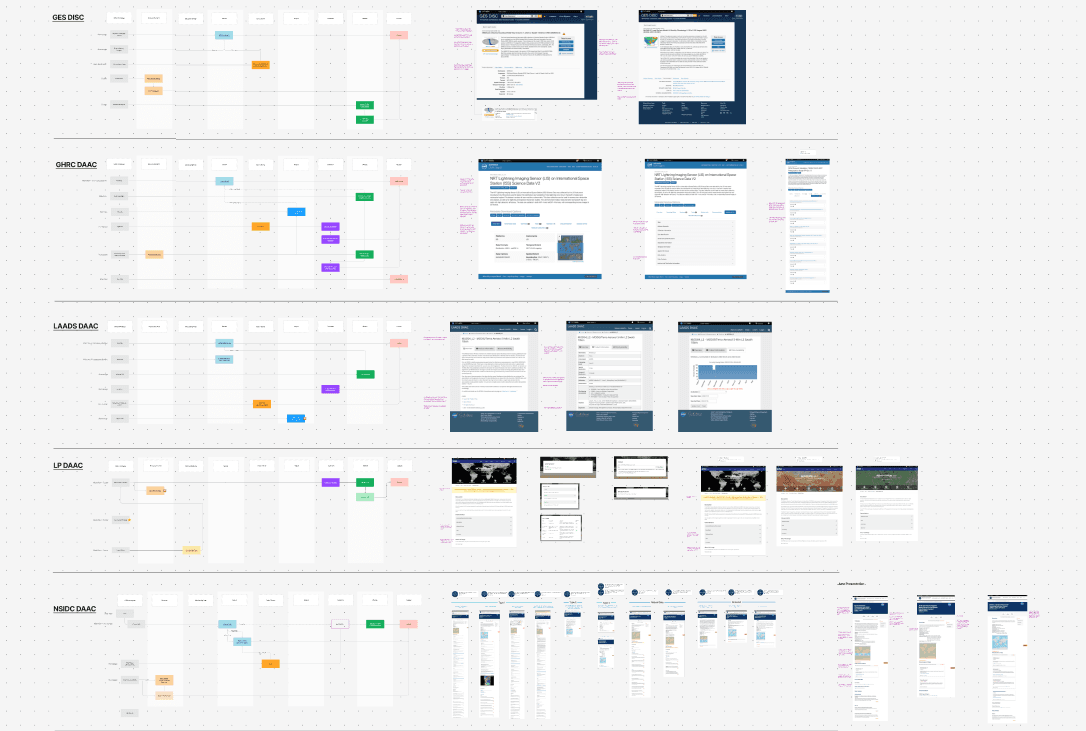
Mapping cross-DAAC discovery workflows uncovered disconnected user journeys that informed the platform's new information architecture.
Mapping cross-DAAC discovery workflows uncovered disconnected user journeys that informed the platform’s new information architecture.
Mapping cross-DAAC discovery workflows uncovered disconnected user journeys that informed the platform’s new information architecture.
Interaction Principle
Consistency builds confidence, even when content varies.
Consistency builds confidence, even when content varies.
NASA’s dataset pages needed to support thousands of products with dramatically different scientific content. Rather than forcing every page into the same template, I focused on the decisions that would make the experience feel predictable while preserving the flexibility each dataset required.
NASA’s dataset pages needed to support thousands of products with dramatically different scientific content. Rather than forcing every page into the same template, I focused on the decisions that would make the experience feel predictable while preserving the flexibility each dataset required.
NASA’s dataset pages needed to support thousands of products with dramatically different scientific content. Rather than forcing every page into the same template, I focused on the decisions that would make the experience feel predictable while preserving the flexibility each dataset required.
Research
Research
Every DAAC organized dataset information differently, forcing users to relearn where to find key details on every page. While the science varied dramatically, the way users evaluated datasets remained remarkably consistent.
A cross-DAAC content inventory became the blueprint for a reusable interaction model. Rather than standardizing every page, I identified the information users consistently needed and created flexible interaction patterns that maintained familiar structure while adapting to each dataset's unique content.
Every DAAC organized dataset information differently, forcing users to relearn where to find key details on every page. While the science varied dramatically, the way users evaluated datasets remained remarkably consistent.
A cross-DAAC content inventory became the blueprint for a reusable interaction model. Rather than standardizing every page, I identified the information users consistently needed and created flexible interaction patterns that maintained familiar structure while adapting to each dataset’s unique content.
Every DAAC organized dataset information differently, forcing users to relearn where to find key details on every page. While the science varied dramatically, the way users evaluated datasets remained remarkably consistent.
A cross-DAAC content inventory became the blueprint for a reusable interaction model. Rather than standardizing every page, I identified the information users consistently needed and created flexible interaction patterns that maintained familiar structure while adapting to each dataset’s unique content.

Content inventory identified key fields across 20 datasets from each of the 12 archive centers.
Content inventory identified key fields across 20 datasets from each of the 12 archive centers.
Content inventory identified key fields across 20 datasets from each of the 12 archive centers.
Prioritizing Information
Prioritizing Information
What should users always see first?
What should users always see first?
Every dataset is different, but the first questions users ask are remarkably consistent: What is this? Is it relevant? Can I use it?
Every dataset is different, but the first questions users ask are remarkably consistent: What is this? Is it relevant? Can I use it?
Design Decision
Prioritized a predictable overview that surfaced the information users needed to assess a dataset before diving into technical details.

Concept directions explored multiple entry points through locations, sectors, topics, interactive maps, and data tools.
Concept directions explored multiple entry points through locations, sectors, topics, interactive maps, and data tools.
Concept directions explored multiple entry points through locations, sectors, topics, interactive maps, and data tools.

Progressive disclosure reveals complexity only when users need it.
Progressive disclosure reveals complexity only when users need it.
Building Confidence
Building Confidence
How do we support beginners without slowing down experts?
How do we support beginners without slowing down experts?
Dataset pages needed to serve first-time visitors looking for a quick answer as well as researchers searching for detailed metadata, documentation, and APIs.
Design Decision
Used progressive disclosure to reveal complexity only when users needed it, keeping the experience approachable while preserving access to advanced information.
Dataset pages needed to serve first-time visitors looking for a quick answer as well as researchers searching for detailed metadata, documentation, and APIs.
Design Decision
Used progressive disclosure to reveal complexity only when users needed it, keeping the experience approachable while preserving access to advanced information.
Reducing Cognitive Load
Reducing Cognitive Load
How can every dataset feel familiar without forcing every page to be identical?
How can every dataset feel familiar without forcing every page to be identical?
Each DAAC manages different scientific data, making a one-size-fits-all template impractical.
Design Decision
Based on the cross-DAAC content inventory to identify shared user needs, I created a modular interaction framework that maintained consistent structure while adapting to each dataset's unique content.
Each DAAC manages different scientific data, making a one-size-fits-all template impractical.
Design Decision
Based on the cross-DAAC content inventory to identify shared user needs, I created a modular interaction framework that maintained consistent structure while adapting to each dataset’s unique content.
Each DAAC manages different scientific data, making a one-size-fits-all template impractical.
Design Decision
Based on the cross-DAAC content inventory to identify shared user needs, I created a modular interaction framework that maintained consistent structure while adapting to each dataset’s unique content.

Examples of three different dataset landing pages across atmosphere, solid earth, and cryosphere disciplines.
Examples of three different dataset landing pages across atmosphere, solid earth, and cryosphere disciplines.
Examples of three different dataset landing pages across atmosphere, solid earth, and cryosphere disciplines.
Outcome
Outcome
A reusable interaction framework that scaled across NASA's Earthdata ecosystem.
A reusable interaction framework that scaled across NASA’s Earthdata ecosystem.
Users could confidently navigate thousands of datasets without relearning the interface, while DAAC teams retained the flexibility to present specialized scientific information in ways that best supported their data.
Users could confidently navigate thousands of datasets without relearning the interface, while DAAC teams retained the flexibility to present specialized scientific information in ways that best supported their data.
IMPACT
Building a Foundation for Future Growth
Building a Foundation for Future Growth
Building a Foundation for Future Growth
By rethinking discovery as a connected ecosystem, this work established a scalable foundation for the future of NASA Earthdata.
By rethinking discovery as a connected ecosystem, this work established a scalable foundation for the future of NASA Earthdata.
By rethinking discovery as a connected ecosystem, this work established a scalable foundation for the future of NASA Earthdata.
Product Strategy
Established a shared product vision that shifted the focus from individual pages to an integrated discovery ecosystem
Established a shared product vision that shifted the focus from individual pages to an integrated discovery ecosystem
Established a shared product vision that shifted the focus from individual pages to an integrated discovery ecosystem
Information Architecture
Created a scalable information architecture and navigation model that supports thousands of datasets across multiple DAACs
Created a scalable information architecture and navigation model that supports thousands of datasets across multiple DAACs
Created a scalable information architecture and navigation model that supports thousands of datasets across multiple DAACs
INTERACTION DESIGN
Designed reusable interaction patterns that reduced cognitive load while supporting both novice and expert users
Designed reusable interaction patterns that reduced cognitive load while supporting both novice and expert users
Designed reusable interaction patterns that reduced cognitive load while supporting both novice and expert users
Design System
Built flexible components and page patterns that enable consistency while adapting to diverse scientific content
Built flexible components and page patterns that enable consistency while adapting to diverse scientific content
Built flexible components and page patterns that enable consistency while adapting to diverse scientific content
✨Principles I Still Design By
This project reinforced my approach to product design: don't remove complexity, design systems that help people navigate it with confidence.